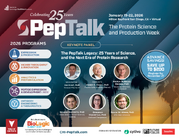

透過小組進行的流暢討論,可促進互動參與,從而解決問題並促進未來針對重點主題的協作。
什麼是小組漫談會?
PepTalk的小組漫談會將就從上游蛋白質表達和生產到下游的放大和生產等各個重要且有趣的主題進行激動人心的討論。讓來自不同領域、具有共同興趣的科學家們彼此進行頭腦風暴和互動解決問題。
The discussions are scheduled for:
Wednesday, January 21, 7:30 - 8:15 am
BuzZ Sessions with Continental Breakfast
Recombinant Protein Production - Part 1
BuzZ Table 1: Recent Developments in Tools for Protein Production: What's Hot and What Have We Not Got (but Need)
Moderator: Christopher Cooper, DPhil, Founder, Protein Sciences, Enzymogen Consulting
- Alternative proteases for fusion tag removal
- Cost-effective reagent-based QC methods
- Protein-labeling technologies
- Up-and-coming fusion tags and promising expression systems
- Is there one hypothetical reagent that would be transformational to your protein production efforts?
BuzZ Table 2: Revisiting Construct Design, Cloning Strategies, and Expression Systems
Moderator: Rob Meijers, PhD, Head, Biological Discovery, Institute for Protein Innovation
- What is the use of codon optimization? Revisiting gene synthesis
- HTP cloning methods; Golden gate assembly, Gibson cloning, etc
- Expression systems revisited (Old and up and coming)
- Expression chaperones, fusion proteins
- Open source cell lines, vectors and media
Automation in Protein Discovery
BuzZ Table 3: Expanding the bsAb Toolbox through Automated Workflows
Moderator: Alexandra Cabatingan, Resin Sales Specialist, Cytiva
- How MabSelect Mild Elution enables streamlined and reproducible platforms
- Using MagSepharose for high-throughput screening
- Automated downstream applications using AKTA chromatography systems and their impact on workflow efficiency
Advanced Tools for Purification and Quality
BuzZ Table 4: Increasing Purification and Characterization Efficiency
Moderator: Gwenny Go, Senior Scientist, Infectious Disease and Vaccines, Merck
- Recent advanced tools and technologies driving purification workflow improvements
- Ensuring the quality of purified proteins: applying diverse analytics and orthogonal measures
- Exploring automated and semi-automated characterization processes. For example, do you trust traditional Western or capillary electrophoresis? Does automated characterization actually save time?
Analytical Strategies for Novel Biologics
BuzZ Table 5: Trends in Analytical Data
Moderator: Marcel Passon, PhD Researcher, Biopharmaceutical Technology, Technical University of Munich
- Join us for an engaging discussion on emerging trends shaping the future of analytical data.
- Explore how organizations are leveraging advanced analytics to enhance decision-making.
- Learn how AI-driven insights are transforming strategies and enabling smarter, data-driven outcomes.
BuzZ Table 6: Current Control Strategies for Characterization- What is Next?
Moderator: Kevin Zen, PhD, Principal Consultant, Biologics CMC Consulting
- How effective are current control strategies in managing variability and ensuring quality?
- What emerging tools and technologies are shaping the next phase of characterization control?
- What does the future of characterization look like?
Peptide Targets: Discovery, Expression, and Validation
BuzZ Table 7: Challenges in Advancing Peptides to the Clinic
Moderator: Raymond S. Norton, PhD, Professor, Monash Institute of Pharmaceutical Sciences, Monash University
- Proteolytic stability
- Pharmacokinetics
- Oral bioavailability
- Cell surface vs intracellular targets
- Cost of goods: synthetic vs recombinant
BuzZ Table 10: Innovations in Peptide Discovery and Hit Validation: Overcoming Bottlenecks
Moderators: Fei Cai, PhD, Scientist 4, Department of Biological Chemistry, Genentech Inc.
Sunhee Hwang, PhD, Scientist 4, Peptide Therapeutics, Genentech Inc.
- Strategies to improve the identification of high-affinity & selective peptide binders
- Focus on early screening of selected hits from discovery efforts (e.g leveraging M/L models)
- How can we prioritize candidates effectively, and what workflows can optimize this process?
- What are the most effective methods for synthesizing peptides quickly and accurately?
- Exploration of innovative approaches including bioproduction
Novel Formats and New Antibody Approaches
BuzZ Table 8: Antibody-Based Technologies for CNS Drug Delivery
Moderator: Peter M. Tessier, PhD, Albert M. Mattocks Professor, Pharmaceutical Sciences & Chemical Engineering, University of Michigan
- CD98hc vs transferrin receptor shuttling: pros/cons & applications
- Impact of bispecific antibody properties on CNS delivery efficiency, selectivity, and retention
- Tailoring antibody shuttles to specific CNS drug delivery applications: nucleic acids, proteins, enzymes, IgGs, and more
- Outstanding challenges in biologics delivery to the CNS and future directions
BuzZ Table 9: Engineering Multispecifics for the Clinic: Potency, Safety, and Manufacturability
Moderator: Hamzeh Rahimi, PhD, Scientist, City of Hope National Medical Center
- Safety-by-design mechanisms
- Potency vs. selectivity engineering
- Manufacturability & developability funnel: what are some early predicters of a go/no go?
* 活動內容有可能不事先告知作更動及調整。
On-Demand only通行證依然持續接受申請。
請透過以下詢問按鍵與我們聯絡。